

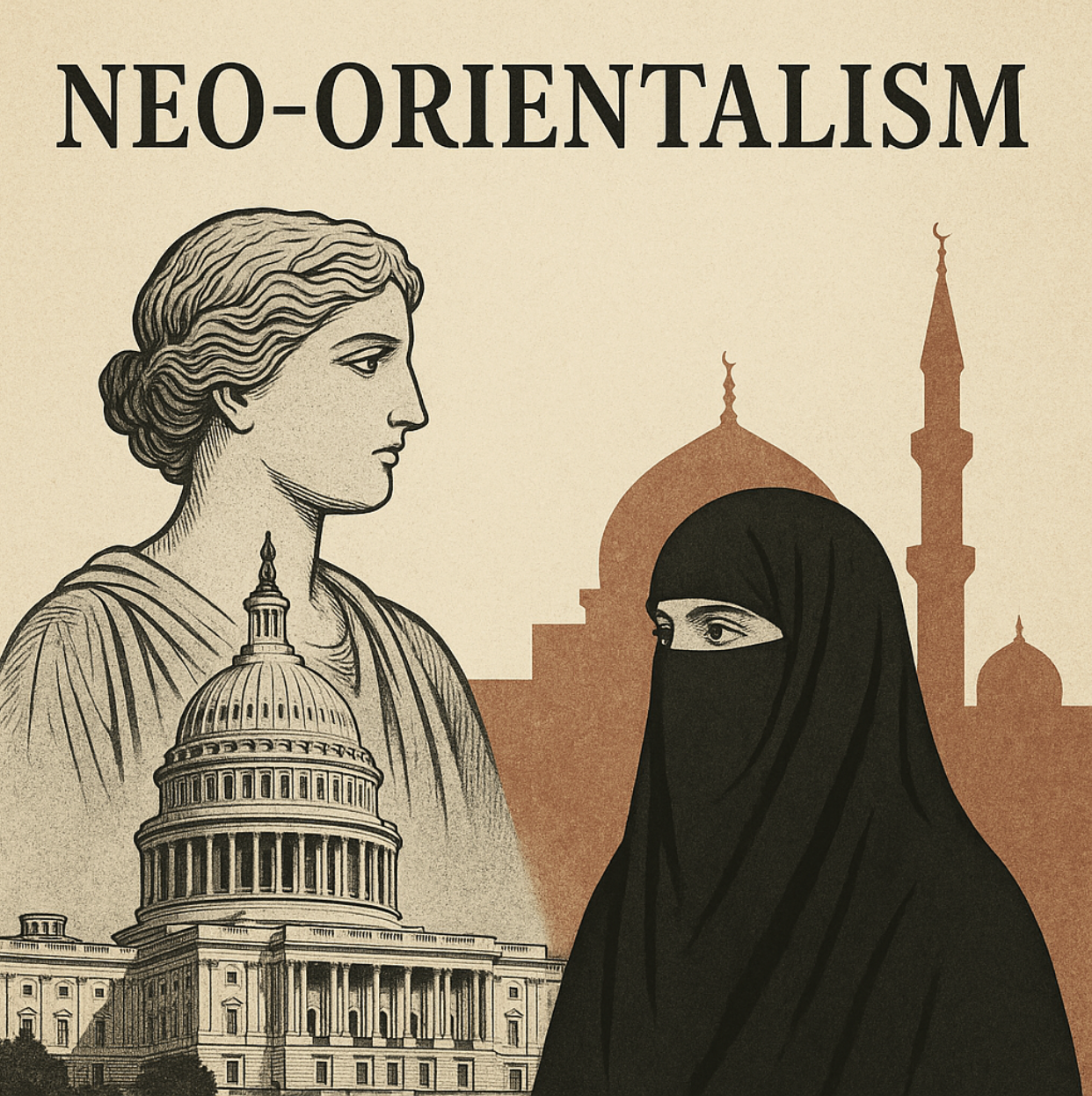
The Impact of Current Events on Western Literature’s Portrayal of the Middle East and North Africa Region

Historically, the ideology of Orientalism was used to divide every aspect of the world into two sections: the East and the West. This framework allowed for the subjugation of many regions by various European countries. Although abated in the 20th century, Orientalism survived and was rebranded into its new version, Neo-Orientalism. This new ideology, focusing on the MENA region and Islam, has led to reductive stereotypes perpetuated by American and European news, literature, and social media. Consequently, there has been a rise in Islamophobia and anti-Muslim violence around the world.

Read More

Lessons from the U.S.-Canada Trade War: The Politics of Attention, Discernment, and Civilian Impact

U.S. President Donald Trump deliberately consumes attention to misdirect the public from focusing on more important matters through distracting spectacles. While domestic instances are relatively trivial, the consequences are serious when expanded to international politics. With his retaliatory justification legally disproven and clearly dishonest, the U.S.-Canada trade war Trump initiated last July proved this point. The resulting public impacts forced Canadian Prime Minister Mark Carney to respond, leaving him with no choice but to legitimize an imagined problem. This demonstrates Trump’s power to dominate the priorities of other leaders, and creates a civilian cost that ultimately threatens greater democratic order.

Read More
Why Can’t We Listen to What Students Value?

The Argentina House at the Cité Universitaire in Paris has come under fire for its policies to combat “woke ideology”, involving restricted common spaces and LGBTQIA+ posters. Far-right ideologies in the national government can be dangerous for students and younger generations. City officials in Paris have responded by asking the foreign ministry to investigate, while the dir

Read More
The Blind Spot in Trafficking Prevention

Trafficking has changed. Organized criminal groups have become more sophisticated, operating across borders and increasingly converging with cyber-enabled fraud, document fraud, money laundering and other forms of organized crime. People can now be trafficked into scam centres and forced to carry out romance scams, investment fraud, cryptocurrency scams and voice phishing, turning victims themselves into instruments of a much larger criminal enterprise. They adapt quickly because they understand something simple: they do not create vulnerability. They exploit it. Our understanding of prevention should evolve just as quickly.

Read More
Following Demosistō’s Call: Designing a UK-Based Hong Kong Referendum

The fundamental demand for a referendum did not disappear with the dissolution of Demosistō in 2020. Rather, it remains one of the most significant unresolved questions arising from Hong Kong’s handover. While political circumstances prevented the implementation of that proposal, the underlying question remains: should Hongkongers be afforded an opportunity to express their preferences regarding their political future?

Read More